Florida
The Florida Department of Transportation connects its Type K temporary concrete barrier with a steel connecting pin. Where the barrier has to be anchored to a bridge deck, approach slab or rigid pavement, FDOT uses either a through bolted anchor or an adhesive-bonded anchor.
Connecting Pin:
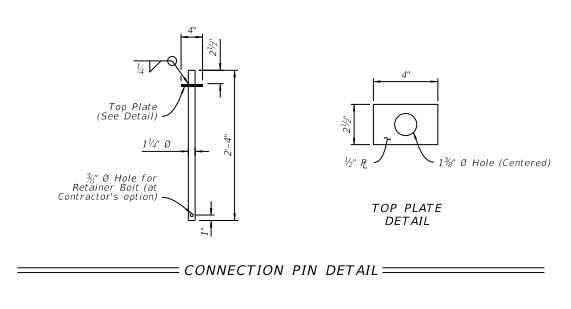
The Type K connecting pin is a 1-1/4″ diameter x 2′-4″ long rod made from ASTM A36 or ASTM A709 Grade 36 steel. A 1/2″ x 4″ x 2-1/2″ top plate with a 1-3/8″ centered hole is fillet welded to the pin 2-1/2″ below the top. The plate rests on the barrier’s connecting loops and holds the pin in place between adjacent units. At the contractor’s option, a 3/8″ hole may be drilled 1″ from the bottom of the pin for a vandal-resistant retainer bolt.
Through Bolted Anchor Pin:
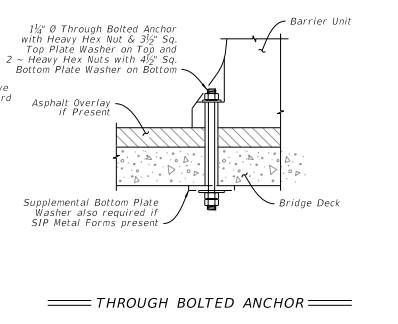
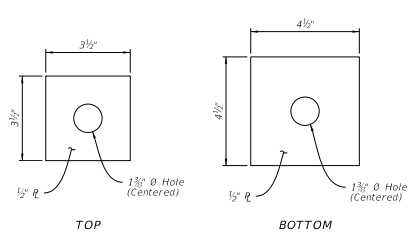
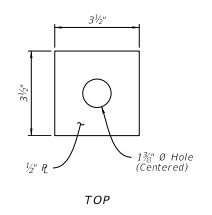
The through bolted anchor pin is a 1-1/4″ diameter rod made from ASTM F1554 Grade 36 or ASTM A307 steel. It passes all the way through the bridge deck or rigid pavement. On top, a heavy hex nut and a 1/2″ x 3-1/2″ square plate washer bear on the barrier toe. Underneath, two heavy hex nuts snugged against each other and a 1/2″ x 4-1/2″ square plate washer hold the anchor to the underside of the deck. A 3/4″ supplemental bottom plate washer is also required where stay-in-place metal forms are present.
Adhesive-Boded Anchor Pin:
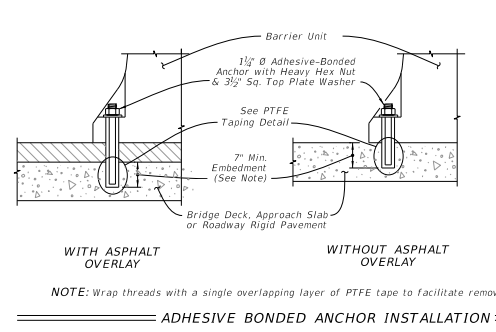
The adhesive-bonded anchor pin is a 1-1/4″ diameter fully threaded rod made from ASTM F1554 Grade 36 steel. It’s set at least 7″ into the concrete deck, approach slab or rigid pavement with a Type HSHV adhesive and it passes through any asphalt overlay on the way down. A heavy hex nut and a 1/2″ x 3-1/2″ square plate washer secure it to the barrier. The threads are wrapped with PTFE tape so the anchor can be removed later.
Anchor Pin – Stake:
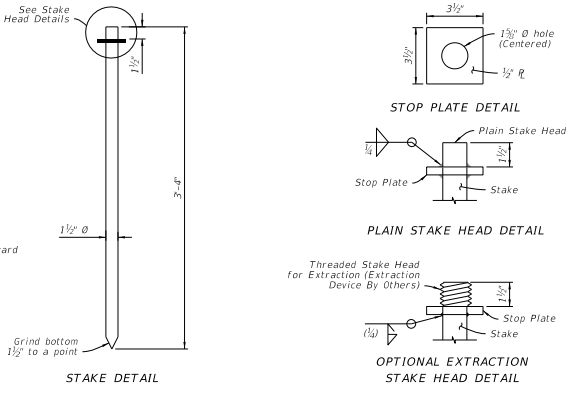
The FDOT Type K stake is a 1-1/2″ diameter x 3′-4″ long steel rod made from ASTM A36 or ASTM A709 Grade 36 steel, with the bottom 1-1/2″ ground to a point. A 1/2″ x 3-1/2″ x 3-1/2″ square stop plate with a 1-5/8″ centered hole is fillet welded to the stake 1-1/2″ below the top. The stake is driven through the barrier toe into flexible pavement or an asphalt pad until the stop plate is snug against the bottom of the anchor blockout.
Stakes come with a plain head, or with an optional threaded head so an extraction device can be screwed on to pull them. Three stakes are installed per barrier unit, on the traffic side only.